Friday, March 14, 2014

Searching for My Grandma's Hamantaschen

It’s Purim again.  You know, that “other” Jewish holiday this time of year that starts with the letter P.  Always the stepchild to Pesach, better known as Passover, even though it occurs earlier in the Hebrew year.

As you may know, Purim celebrates the Jews’ survival from another threat to their existence.  Actually, that seems to be the theme to many Jewish holidays: Passover and Chanukah come to mind.  Purim dates back to the 4th century BCE when Jews faced eradication in Persia during the rule of King Ahasuerus.  His grand vizier, Haman, apparently felt himself insulted by Mordecai, a Jew who refused to bow down to Haman, and Haman decided to kill all the Jews.  Fortunately, however, the Queen of Persia, Esther, just so happened to be Jewish, although neither the King nor Haman knew this at the time Haman devised his plot to kill the Jews.  Mordecai, who was Esther’s cousin and guardian, convinced Esther to intercede with the King which she successfully did. As a result, Haman faced the gallows. The Jews survived. For those who want the authentic story not distorted by my abbreviated version, read the Book of Esther in the Old Testament.  For those who need a website, try http://en.wikipedia.org/wiki/Book_of_Esther.

As a child, I loved Purim, far more than I loved Passover.  During Passover I could not eat my favorite foods.  When I was growing up, the number of foods that were “kosher for Passover” was limited.  One of my favorite “foods,” using that term loosely, Heinz Ketchup, was not made kosher for Passover despite my unanswered plea to the Heinz company by letter in the 1950’s.  Some of the best chocolate were also not available.

But Purim, which admittedly only lasted a day, had abundant treats, most notably hamantaschen.  What are hamantaschen, you ask?  A hamantasch is a filled-pocket cookie or pastry in Ashkenazi Jewish cuisine recognizable for its three-cornered shape. The shape is achieved by folding in the sides of a circular piece of dough, with a filling placed in the center.  The filling is often poppy seeds but sometimes prunes or other delights.  The pastry draws its name from Haman, of course, and is eaten as part of the festivities celebrating Jewish survival and Haman’s downfall. 

During Purim, the Megillah of Esther, the Scroll or Book of Esther, is read at the synagogue.  Young children furiously shake noisemakers or groggers every time Haman’s name is mentioned during the reading.  Then it’s back home for the hamantaschen.  I imagine there was some deep religious discussion that accompanied the celebration of Purim when I was a child but, frankly, that was lost in translation!

In any case, my family would always travel to my mother’s parents’ home when I, my brother and sister, were children, and there we would devour Grandma’s hamantaschen.  They were absolutely delicious.  We would always take a truckload of them home with us.  Grandma’s hamantaschen were filled with prunes and were large, soft shelled and puffy.

Ever since my childhood I have longed for my Grandma’s hamantaschen. One year, decades ago, my mother made a batch and mailed them to me in California.  Since then, however, I have sought my Grandma’s hamantaschen in vein.  I searched various Jewish bakeries in Southern California to no avail.

This year I decided to at least try to figure out what made my Grandma’s hamantaschen so different than all the others I have tasted.  And I’ve discovered the key!  My Grandma did not use cookie dough, whether soft or hard, to make her hamantaschen.  Most who make hamantaschen use cookie dough.  My Grandma used dough with yeast that yielded a much softer pastry with a brownish color.  Unlike most cookie dough hamantaschen which crumble before they reach your mouth, Grandma’s hamantaschen retained their shape until disappearing inside our mouths.

I was able to find several sources on the Web that distinguish Grandma’s kind of hamantaschen from the usual cookie dough variety.

The usual cookie dough variety of hamantaschen typically looks like this:
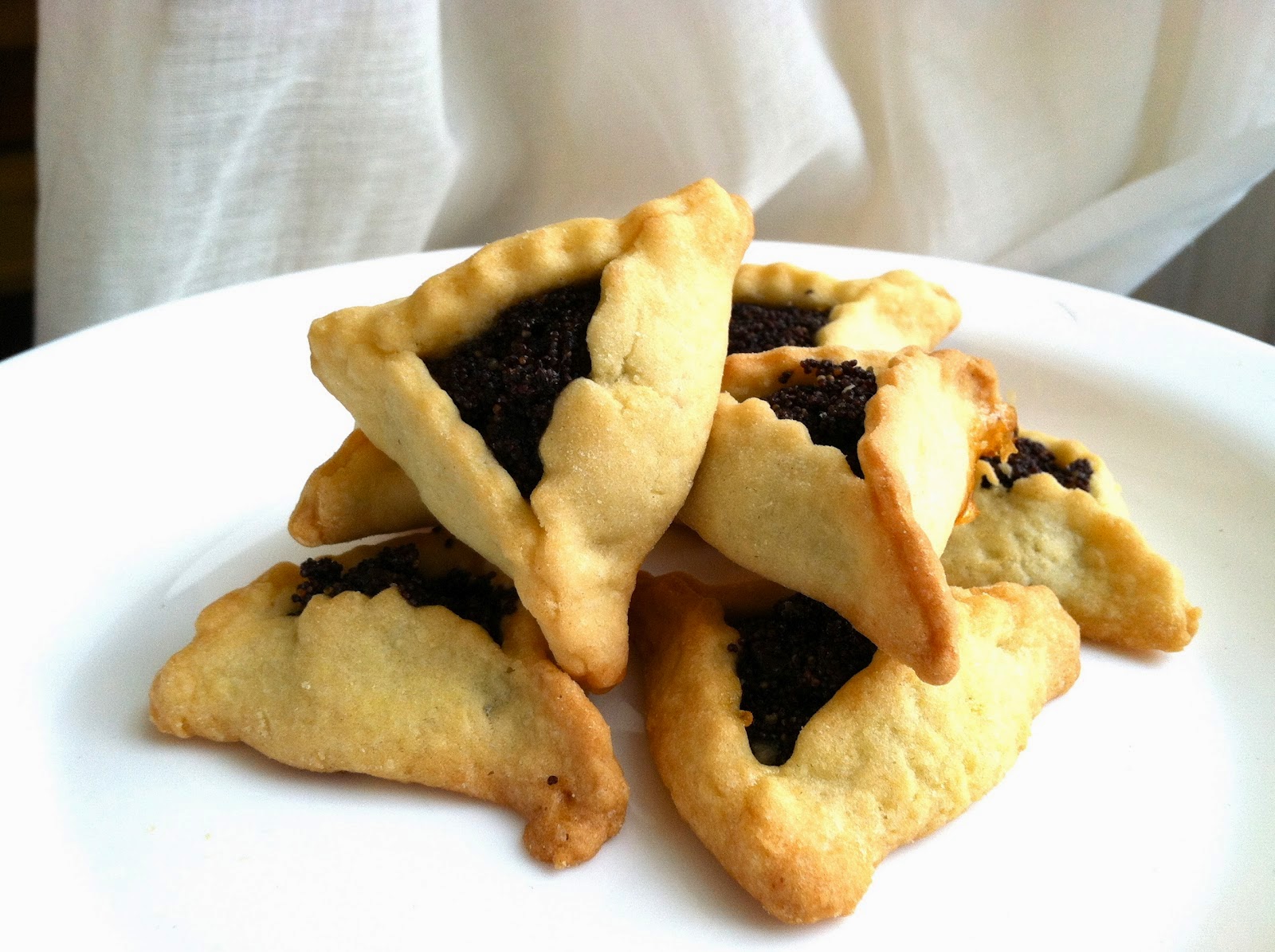


In contrast, my Grandma’s hamantaschen looked like this:


Now I must find someone who knows how to cook to make my Grandma’s hamantaschen.  Then life would be sweet!

Saturday, March 1, 2014

Why I Love My Google Maps and Waze Apps

I had occasion to use both my Google Maps and Waze applications on my iPhone today, February 28th, while navigating from my home to West Los Angeles and back for a delightful lunch with two former college classmates.  The inclement weather gave me concerns about freeway driving so I turned to these GPS navigation tools for help.  And, in the course of using the devices I realized why I really love them.

Aside from the soothing female voice that provides directions, I think the key to my affection for these GPS applications is simple: no matter how often I disregard the directions I am being given and take some other route, she never gets angry at me, never yells at me, never tells me how dumb I am for disregarding her directions, always remains calm and always remains unflappable.  No matter how misguided my decision was, she simply recalibrates the route to coincide with the new path I have taken and provides me with a new set of instructions designed to get me to my destination.


Lest you think my feelings toward Google Maps and Waze say more about me than about these applications, well, what can I say!

Tuesday, December 17, 2013

Reflections | December 17, 2013


In reaction to Pope Francis’ birthday, I was once again reminded of how my views of powerful public figures have changed as I have aged, and I tweeted the following:


When I was young the Pope was very old distant figure. Now only 6 yrs Pope #Francis' junior, I see him as wise but far more human. @Pontifex

5:41 PM - 17 Dec 13

I remember how I felt upon Bill Clinton’s election as President, realizing that for the first time I was older than the President.  A different perspective, at least for me.

I also found this ‘cartoon’ on point, meaning that it reflects my own thinking:


The Selfless by Gary Barker @barkercartoons 

Monday, December 2, 2013

Chocolate Chip Cookies Yes. Computer Cookies NO!!


Yes I like cookies, but increasingly not the computer kind. All you have to do is glance at a product on a webpage. Not buy. Not wish list it. Just glance. And for the next few hours, days, perhaps years, everytime you go to a different webpage there’s a promotion or ad for the product you glanced at glaring at you from the new webpage. Sheesh.

Monday, October 28, 2013

Start TV Programs On The Hour

There was a time when television programs commenced exactly on the hour or half-hour.  You could count on it.  You could take care of necessaries before your favorite program began.  No longer.

Nowadays it appears that many TV programs start two minutes or one minute before the hour.  That’s crazy.  It’s ridiculous.  And why are the networks doing this to us?

Perhaps there are articles reviewing this practice.  I haven’t found them.  Then again, I haven’t looked for them.  I assume the reason for this change is “competition.”  The networks have decided that providing a brief preview to the next program as a teaser won’t suffice.  Instead, they have to launch the next program a minute before the hour, presumably a minute before their competition, until their competitors decide to match that strategy.

Stop this madness, Networks!  Yes, you.  You seem to be the main offenders although I’ve found this practice rampant on cable channels, such as MsNBC, of late.


Go back to the certainty of starting programs on the hour or half hour.  Stop starting programs a minute or even two minutes before the hour.  Give us a chance to refresh between programs without having to worry that we’ve missed the first minute or two, often the most important in melodramas.

Monday, October 7, 2013

Gridlock, Shutdown, Paralysis

As the shutdown enters another week I have no difficulty placing blame entirely on the Republicans.  I am not saying that Democrats are angels or that one can't reach back in history and find some Democratic legislative action that didn't adhere to the "principles" Democrats enunciate today.  But this obsessive preoccupation with the Affordable Care Act (“ObamaCare”) is destructive, perhaps not to the Republican Party but to the nation.  It is true that only Democrats voted for the legislation when it passed, but even then that was in large measure because Republicans really didn't want to negotiate over a bill that they would then seemingly support.  Even at that point Republicans were rejecting Heritage Foundation and Newt Gingrich principles about individual responsibility and an individual mandate and have continued to do so.  Obama made deals with the medical profession, the insurance industry and even with the pharmaceutical industry in trying to craft a law that would pass.  He accommodated conservative elements in the Democratic Party as well to achieve the necessary majority vote.  ACA is not some socialist dream.  It is not a take over of medical care by the government.  In fact, Obama chose not to embrace a single payer system along the lines of Medicare, which would have involved a greater governmental involvement.  If anything,  ACA is a boon to private enterprise as millions of Americans will now purchase insurance in the marketplace.

Instead of working with Obama to craft legislation in part reflecting their views, instead of trying to effectuate meaningful and helpful changes to ACA as questions and concerns over parts of the law have emerged, Republicans have been dead set on repealing it.  They challenged the constitutionality of the individual mandate, taking their claim to the U.S. Supreme Court.  But, the High Court upheld the law.  In the last several years, the House, led by Tea Party Republicans, has voted at least 42 times to repeal the law, an effort dead in its tracks given Democratic control of the Senate and the White House.  Now the Republican Party has shut down major parts of the Federal Government in an effort to force the Democrats in Congress to rescind ACA, something Obama will not accept.

Holding the country hostage by first threatening to shut and now shutting down the Federal Government in an attempt to compel the other Party to vote to rescind existing legislation is simply not appropriate.  Let the Republicans capture control of the Senate and, if also needed, the White House, something they claim they can do given the public’s alleged distaste for the ACA.  Or negotiate over other legislation desired by Democrats.  But shutting down the Government to overturn legislation lawfully enacted and upheld by the Supreme Court is, indeed, nothing but hostage taking.  The President’s refusal to negotiate in this situation is reasonable.

In a little over a week it will be necessary for the Congress to raise the debt ceiling to avoid a Government default on obligations Congress has already incurred.  Again Republicans wish to hold this requirement hostage in exchange for Democratic concessions over the ACA and/or the extent of America’s debt and deficit spending.  The Republicans took this same approach previously and gained concessions from Obama as well as caused a downgrading of America’s credit rating, meaning that the cost of federal borrowing increased.

President Obama has refused to negotiate over an increase in the debt ceiling this time, claiming that Congress has already incurred the obligations necessitating an increase in the ceiling, and that America should not have to experience this constant brinkmanship in its financial affairs.  Speaker John Boehner has said he won't undermine America's credit but he and his Republicans seem eager to push Obama toward further concessions in order to approve an increase in the debt ceiling.  Obama claims that he is willing to negotiate on any topic, but not in exchange for keeping the Government open or funding America’s current obligations.  There has been talk again about a “grand bargain” under which Obama might agree to some changes in entitlements in exchange for an increase in the debt ceiling and other Republican concessions.  But Obama has made clear that his “grand bargain” includes further tax increases and reforms, something Tea Party Republicans adamantly oppose.

Is there any end in sight to this continuing stalemate?  A grand bargain?  Chances of that seem slight.  Republicans are likely to retain a majority in the House even if more voters support Democratic candidates than Republicans.  This reflects the structure of American government, gerrymandered districts, and population concentrations.  Any chance of a Republican takeover of the Senate in the 2014 elections?  That is a possibility although the current shutdown may hurt GOP chances.  How about a Republican sweep of Congress and the Presidency by 2016?  There is certainly a chance that by then the public will want a change in parties in the White House.  That happened in 1992, again in 2000, and in 2008.  But the nation’s demographics are in flux, Republicans have yet to develop an appeal toward Hispanics, and the cultural divide particularly between the Tea Party Republicans and much of the rest of the country remains vast.

This stalemate over Government funding and the debt ceiling is not healthy for this country.  I share the President’s perspective that these two issues should not be held hostage by Republicans as a way to extract concessions on other policy issues.

Policy decisions need to be made to address America’s demographic changes, immigration issues, deterioration in infrastructure, exploding cost of entitlements, tepid economic growth.  But at the moment gridlock in Washington seems to preclude any movement on these issues.  Negotiation and compromise on these specific policy issues and others are needed.  But currently compromise appears to be a dirty word, particularly to Tea Party true believers.  Fissures in the Republican Party further reflect the extremism of the GOP right wing.  Answers to resolving this situation seem few and far between.  There is paralysis in Washington.  Exceptional leadership is necessary but is not being shown by either Party or by President Obama.  One can hope.

Friday, September 27, 2013

Reflections on Obama and Negotiating with Iran

Not surprisingly, there has been a spate of criticism of late of President Barack Obama over the quality of his leadership in foreign affairs.  The claim is that "Obama is weak, he's unwilling to take strong action, and our adversaries know that about him and will humiliate him and run circles around him."  My view?  Poppycock.

I don't know whether a meaningful deal is possible with the Iranians.  No doubt President Hassan Rouhani is on a charm offensive.  A number of critics point out that he did this once before, with the Europeans, and succeeded in charming his adversaries into stepping back while Iran kept developing its centrifuges.  I don't pretend to know the full story but perhaps that is true.

I remain skeptical about a deal because I strongly believe that the Iranians in almost all quarters want nuclear weapons.  Not only do the hardliners want nuclear weapons, but I suspect even the youth of the country who may feel oppressed by the mullahs either want, or at least don't like the idea of being pressured by outsiders from building, nuclear weapons.  Having nuclear weapons is a sign of prestige and national pride, when Pakistan and India have nuclear weapons, and a measure of 'equality' and deterrent vis-a-vis Israel, which is presumed by most to have them.

Does that mean that negotiations will fail or that any agreement will mean the United States and the West will be fooled because Iran will nonetheless continue to develop nuclear weapons?  We're told that is what North Korea appears to have done; that North Korea made deals but did not abide by them and now has nuclear weapons.  Will Iran follow North Korea's lead and, even if a deal is reached with the West, continue to develop nuclear weapons in violation of its terms?  Perhaps.  Obviously the only conceivable way that outcome may be avoided is if Iran’s nuclear activities are fully transparent and if verification of Iran's status is constant and intrusive, and those requirements are not easily met.

Hence the skepticism.  But does that mean Obama is a weak President and a poor negotiator?  No.  But critics point to the Syria situation, claiming Obama drew a bright red line a year ago over Syria’s use of chemical weapons and then proceeded to turn a blind eye for a year to Assad's use of chemical weapons, and then, following the extensive and deadly use of chemical weapons on August 21, 2013, Obama made threats of military action but continued to equivocate, seeking Congressional support.cc

Perhaps George W. Bush, had he still been President, would have attacked Syria regardless of the vote in the British Parliament, strong American public opinion against any military involvement, and a Congress very hesitant to support military action particularly in light of popular opinion.  But after his own disastrous Iraq War and the mess in Afghanistan he helped bring about, it isn't at all clear that George W would have disregarded these obstacles and launched an attack, despite the likelihood that Cheney would have been urging him to do so.  What does seem to be relatively clear is that Obama's threat to use military force against Syria finally spurred Russia into proposing to intervene and seek to persuade Assad to agree to relinquish his chemical weapons.  Perhaps that is nothing but a stalling tactic but it remains to be seen.  Syria has been providing some information required under the agreement and the United Nations Security Council has apparently approved a resolution that, while not promulgated under Article 7, nonetheless holds out the likelihood of sanctions under Article 7 if Syria fails to comply.

There is no question that Obama is slow moving and cautious when it comes to American military action abroad.  He spent an inordinate amount of time to decide whether or not to send more American troops to Afghanistan soon after he became President in response to a call by others for an Afghanistan surge.  He hesitated over involving the United States in Libya when the so-called Arab Spring reached its shores and then, when he finally decided to act, chose to provide limited military support and, in the words of his critics, "lead from behind."  He has held back during his Presidency from direct involvement in the Israeli-Palestinian situation, only acting recently to encourage renewed negotiations as a result of Secretary Kerry's initiative.  This hesitancy seems not only to reflect his overall personality as one who acts cautiously only after careful consideration of a situation but also his awareness of America's intense fatigue with foreign military involvement following Iraq and Afghanistan as well as the limits of American military power in effectuating positive outcomes around the world.

But being slow moving and cautious, perhaps ultra-cautious at times, does not mean weakness.  Obama has taken risks and has made moves when he has decided such actions serve America's national interest.  He approved the daring mission to bring Osama bin Laden to justice.  While garnering criticism from some quarters, Obama has utilized drone attacks in foreign countries in pursuit of terrorist leaders.  And, while he sought Congressional approval for military action against Syria, it is far from clear that he would have taken no military action had Congress failed to support his request.

Obama knows that America does not want to go to war against Iran.  He knows that Iran is aware of American public opinion.  At the same time, the United States has tightened economic sanctions against Iran during Obama’s tenure in office and those sanctions seem to have succeeded at least in some measure in making life extremely difficult in Iran.  Israel has threatened to take military action against Iran at some point if its nuclear weapons program is not stopped.  And, despite reticence on the part of the American public and Obama himself, America has indicated the possibility that it will initiate military action against Iran to avoid Iran developing nuclear weapons.  These are not insignificant threats to Iran and there is reason to believe that Iran's leadership takes them as meaningful threats.

It is in this context, a strong desire among Americans and in the West against another Middle East war but strong concerns among Western powers about the prospect of Iran developing nuclear weapons, including concerns for the West’s Middle East Sunni Arab allies who will likely not stand idly by if Iran develops nuclear weapons but will seek to develop their own, as well as for Israel, that a possible deal between the United States and its allies and Iran may emerge.  Will Iran truly be willing to stop its nuclear weapons program and give sufficient access to international organizations and personnel to verify such an action in exchange for the ending of economic and other sanctions against Iran and the end to military threats against Iran?  Perhaps so.  But we won't know unless a full attempt to reach an accord is made, against a clock that continues to tick.  Is Obama strong enough to engage in intense negotiations to reach this outcome, which will require an ability to show a willingness to reach a compromise balanced by an ability to project a willingness to use military force if needed?  I believe the answer is Yes.